Saturday, April 14, 2012

Sigur Ros - This is a Good Beginning


In spite of my long list of knits waiting to be finished for other people, I've taken a creative break to make myself some socks and stockings.

Like the fairytale cobbler whose children go shoe-less, all of my socks are grocery-store-bought black of an indeterminate fiber and have holes in the heels. Sadly, this isn't a new state of affairs. I gamely sew up the holes and continue wearing them while knitting away on gifts for others.

Well, last week I said (to myself) "No more"! I'm going to knit up a drawfull of stockings for myself before I finish anything for anyone else!

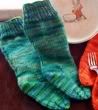
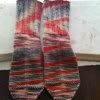
So, the picture shows my first pair, finished yesterday. They are made from Blue Moon Fiber Arts STR lightweight in Sigur Ros (one of my favorite bands). The cast on was 60 stitches and I used size 2.5mm Darn Pretty DPN Needles. I used a simple stitch pattern - 3x2 rib - in a simple formula - cuff down, short-row heel, and star decreased toe (no Kitchener!).

I wore them as soon as they were off the needles - not even waiting to block them, though I know blocking would soften the yarn even more than it already is and help it to 'bloom'. They are super comfy!

I've already begun the second pair: Rainy Day Socks using Madeline Tosh Sock in Wash. I hope the Force for sock-knitting stays strong in me. I want lots and lots!

Sunday, April 8, 2012

Bunny Ears, Oysters and Spring Hats

Photobucket

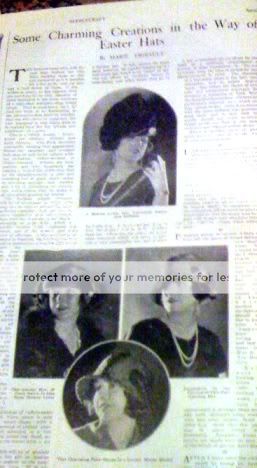
Yesterday, we went for a long drive to visit the boyfriend's relatives. Yes, that is one of his relatives wearing bunny ears. Everyone thought it was very cute but I was deathly and silently afraid she was going wear them out the restaurant for lunch! I'm such a wimp sometimes... now, if she'd been wearing a quirky vintage hat or cloche, like these in my 1923 April Needlework Magazine, I wouldn't have batted an eye!

Photobucket

We went to a wonderful restaurant called The Wicked Oyster.

Photobucket

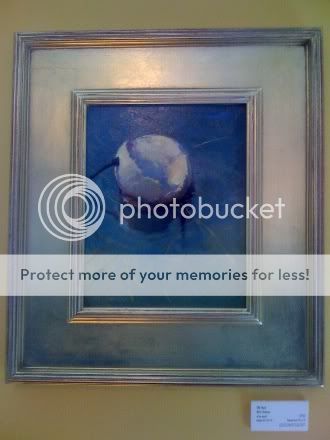
The walls were lined with the most beautiful paintings by local artists - all very expensive but mostly of the ocean...


Photobucket

The menu was all oysters. Others ordered spinach salad, but my boyfriend and I ordered buttermilk fried oysters with homemade cocktail sauce. They were incredible.


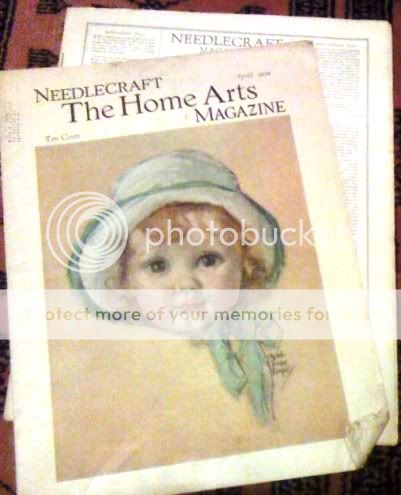
I looked through my stack of old Needlework Magazines for the April versions, but only found two, one from 1923 without a cover and the other from 1934:

Photobucket

The New Spring Styles were loose and flowing


and the patterns were focused on filet crochet


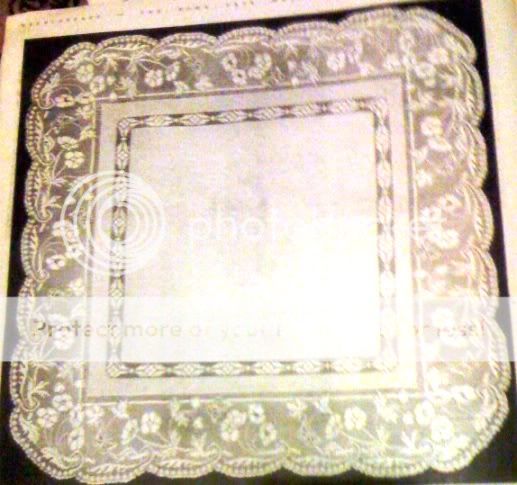
There was a beautiful Anemone Tea Cloth illustrated, by the wonderful Mary Card of Australia, but as usual the pattern wasn't included.

Photobucket

I've always wondered if they expected the readers to copy the pattern by just looking at the over-sized photograph of her gorgeous filet designs.

There were no recipes for oysters in these April magazines, but they recommended lots of eggs - deviled eggs being the finger food of choice for a spring holiday luncheon:

Photobucket

and their argument for a Spring diet of eggs:

It's Spring, and Easter, and Nature is "recovering" from winter according to her own ancient laws, while poor old human nature is muddling along, trying to correct the mistakes they have made in selfishness, and greed, in war, and in peace. Learning the laws of being, and being true to them, is all that brings a good crop, be it in the cabbage patch, in the university, or in the college of Life. So much for our brief Easter sermon, and nobody can corner the joy to be had in the spring - it's there for the looking and the sniffing; the earth itself smells good in the spring as the frost leaves it... Use your senses in the spring- meet it with an alertness and an awakening to the simple joys that are free to all. If you can 'sit on a log and pat a dog, do it; it's fun in the springtime.


The 1934 recipe for spring eggs:

Eggs Florentine

Place two cups of minced buttered spinach in a baking dish. Break four eggs over this, season and pour over all half a cup of medium white sauce to which a quarter cup of grated cheese is added. Sprinkle with two tablespoons of melted butter and slip under the broiler to set the eggs and brown lightly.


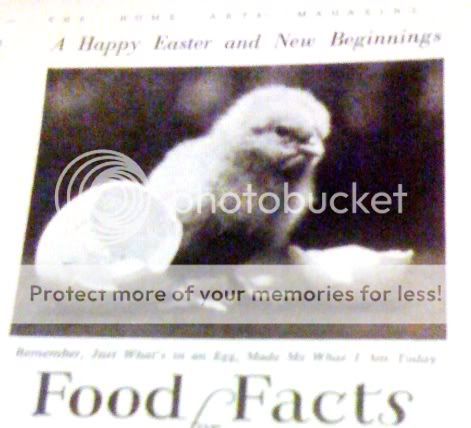
Happy Spring! May you have a new (vintage) bonnet on your needles!

Wednesday, April 4, 2012

Spring and All That...

Spring
by Pablo Neruda

The bird has come
to bring light to birth.
From every trill of his,
water is born.


And in between the water and light
which unwind in the air,
the spring is now beginning,


now the seed is aware of its own growing;
the root takes shape in the corolla,
at last the eyelids of the pollen open.


All this accomplished by a simple bird
from his perch on a green branch.


Photobucket

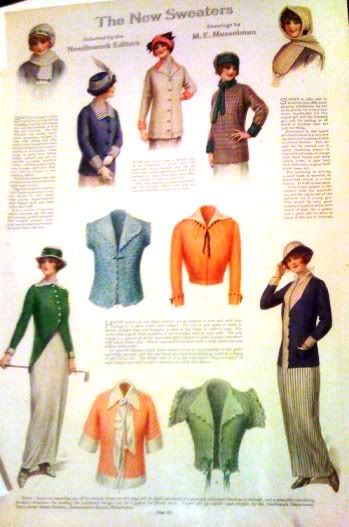
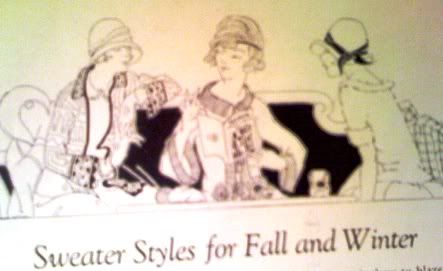
My same friend who send me the vintage booklets in my last post, sent me this beautiful page of spring sweaters from an unknown vintage magazine. It looks very much like the Needlework Magazine, printed in Augusta Maine and spanning the globe in distribution. And I appear to be correct in that assumption, because I just went to look at this page again and it says clearly: The New Sweaters, selected by the Needlework Editors!

The drawings - quite beautiful! - were made by M.E. Musselman and all reflect a lighter brighter sensibility for Spring. I love the greens especially, but the coral oranges are spot on for this year's trend of tangerine!

Photobucket

In the description, silk is extolled as the perfect fiber for this time of year. They go on to say that silk sweaters are "chiefly ready-made garments" and "It is a matter of personal choice between the silk and the worsted, as both are good. The worsted sweater, however, can be made more easily by hand than a silk one." Ah, don't I know it!

Photobucket

I am very drawn to scarves that incorporate hoods, and it appears that this is a fashion trend over 100 years old.

Photobucket

Scarfs in silks and in worsteds, too, offer most pleasing substitutes for fur neck-pieces for every-day wear, especially for the school girl and the business girl, and for outings in kinds of weather they are just the thing.
Illustrated in the upper left-hand corner is a very new cap and scarf with crocheted flowers. This design can be carried out in many charming colours - in blue with red roses, in orange with blank bands and deep yellow roses, in pale blue with pink roses, in grey with white roses, etc.
For motoring or driving a scarf hood in worsted, as illustrated above, is a real luxury. It is all in one piece.

Photobucket

And finally, a little note at the bottom says that a pamphlet containing the working directions for the items shown will be supplied for 15 cents. Oh how I wish that someone had sent away for this pamphlet and that it had made its way into my hands! I would love to make the motoring hood-scarf, the white center-top sweater-jacket, the coral Spencer with its gathered neckline on the right, and the green cut-away sweater with its white collar and cuffs on the left - just for wearing in the Spring!

Monday, March 26, 2012

Front Page News in Knitting

Photobucket

Photobucket

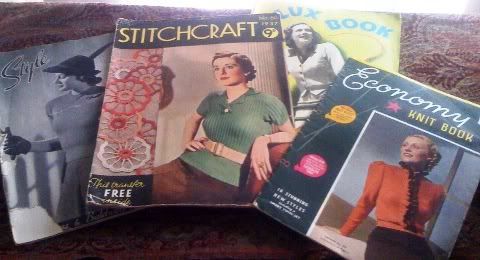
A final wonderful birthday package arrived on my doorstep, from my friend in Australia! I love the pattern books and ephemera that he sends me so, so much! These booklets are from the late 1930's through the very early 1940's.

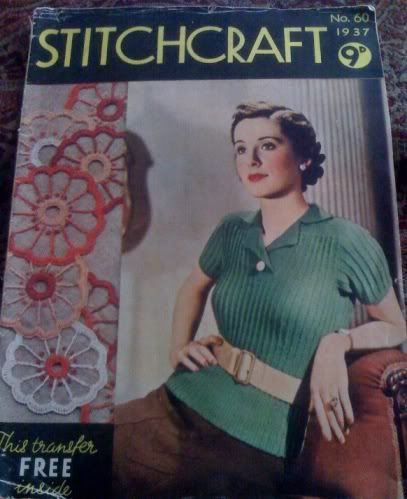
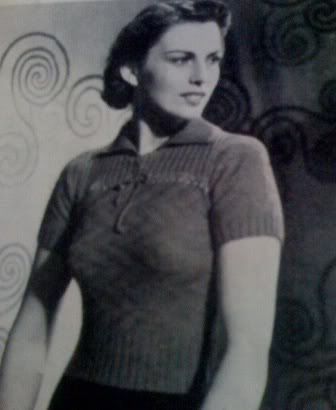
This Stitchcraft No. 60 from 1937 is a great example of how knitting styles were becoming more sporty and suitable for everyday wear.

Photobucket

A belt and a hat made a knitted blouse or sweater "office wear" while a pair of trousers or shorts made that knitted sweater just right for the weekend...

Photobucket

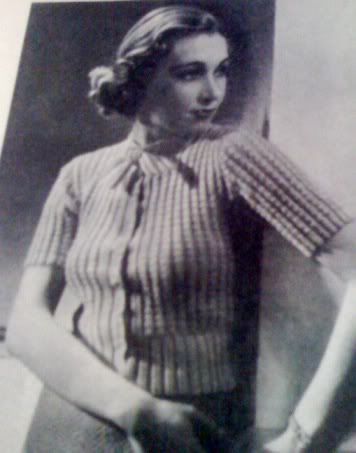
I love the little neck bow on this one, and it's always the details that charm me:

Photobucket

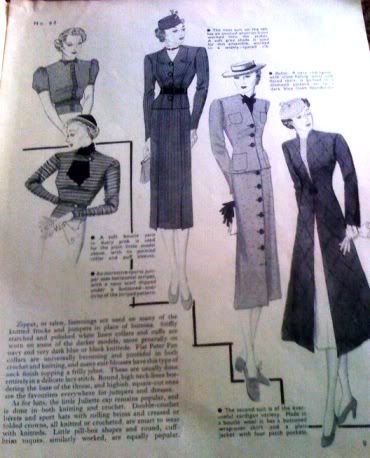
Stitchcraft features several crafts, as well as lots of knitting patterns and this magazine still has it's embroidery transfer inside. There are recipes (ham loaf served with beans and sliced boiled potato - a regular starch feast!), sewing tips, and other crafts. This style page is called "Knitted by the Sea" by Anne Talbot and the designs are all knitted, even the suits and coat:

Photobucket

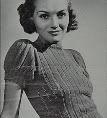
It's only meant to show the reader what's in style though; the patterns aren't included, sadly. The top blouse in the picture is described this way: "A soft boucle yarn in dusty pink is used for the plain little model above, with its pointed collar and puff sleeves"

and the cute striped one says: "An attractive sports jumper uses horizontal stripes, with a navy scarf slipped under a buttoned-over strap of the striped pattern"

But Ms. Talbot's description of hte fashions of the that summer of 1937 are particularly charming, so I'll quote just a small portion of here for your review:

Deauville, Le Touquet, and other Channel resorts are now crowded with smartly-clad Parisiennes and fashionable cosmopolitaines. In the fifteen years that I have been going to Deauville and Le Touquet I have noticed a very gradual, but markedly definite, change in the type of informal costumes work by the "smart set." These daytime clothes have become more practical and more "sporting" in every way. But what is of most interest to readers of Stitchcraft is that the importance of knitwear can scarcely be exaggerated. Knitteds have become so essential to the holiday wardrobe that no fashionable Parisienne would dream of being without a variety of models.

For very hot weather there are lovely, fine linen and cotton threads, delightful for both crocheting and knitting. Synthetic threads, such as artificial silk and kindred substances, are likewise very cool and when mixed with wool, as they so frequently are, make most practical and beautiful yarns...


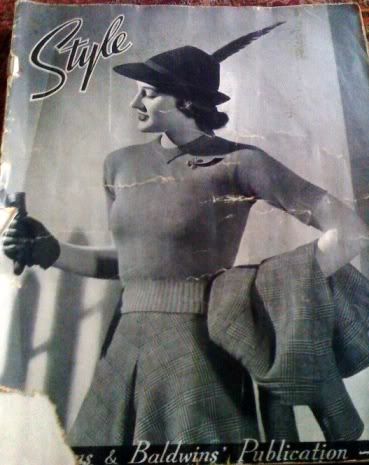
The next booklet is Style, by Patons & Baldwins, Volume 7. The corner where the date was is torn a bit, but it definitely appears to be from the same late 30's time period. Note the charming Robin Hood hat!

Photobucket

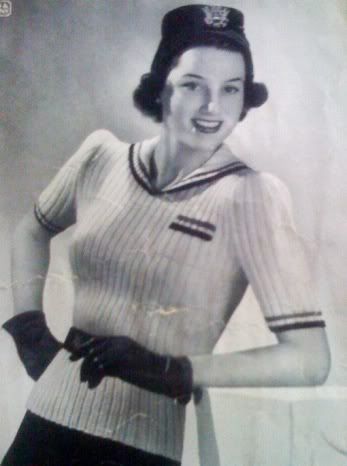
In some ways, the fashions of that time were like costumes - the cosplay of the 1930's! And here's a jaunty Sailor style from this booklet:

Photobucket

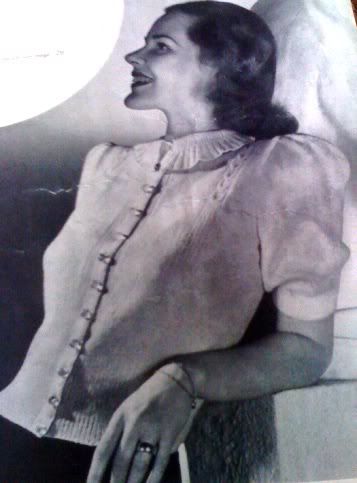
This blouse is cute with its ruffled collar, big puffed sleeves, and little cables... it's called The Charmer"

Photobucket

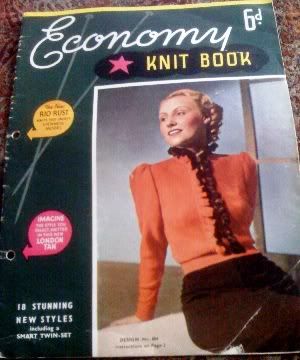
The next booklet I'll review is called "The Economy Knit Book - 18 Stunning New Styles." from Woolworth's.

Photobucket

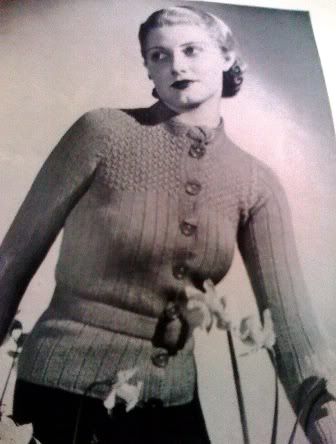
I have a couple of very old Woolworth's knitting books and they are so wonderful! This one is no exception, and appears to be from the early 40's when this style of slightly military-looking cardigan jacket was popular:

Photobucket

This booklet is unique in that throughout the booklet the knit patterns are modeled by contemporary Hollywood stars! It's so adorable, with pattern titles like:

You'll Look Ultra-Smart in this Jaunty Viennese Model
Imagine This Unusual Puff-Sleeved Style in Three Colours
Stylish for Weekends - Smart for Business Too!
When You Get That Cruising Feeling!
This Will Look Very Sweet on You
Look Lovely on Your Next Holiday - Here's How!
Knit This for Lots of Use in the Snow Country!

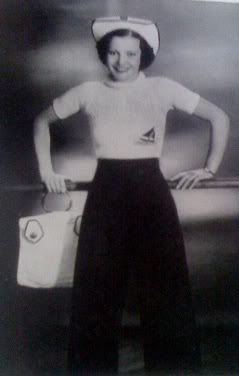
Here is the Woolworth version of the Sailor Suit, with the title, "Announcing the Roly-Poly Neck - Present American Craze!" The placement of that little sailboat applique certainly ensures that it will bob up and down on the the...erm...waves, doesn't it?

Photobucket

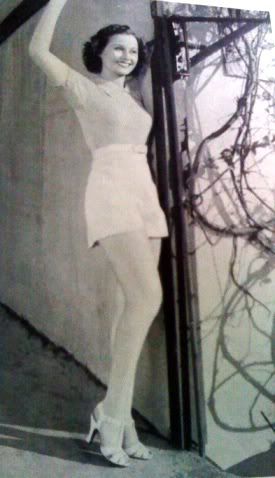
Some of the movie stars are Frank Forest (Paramount Studios), modeling "The Favorite Sweater of Men About Hollywood"... Binnie Barnes (Universal Studios), "Introducing a Smart Twin Set"... Nola Warren ("Australian Film Star")... Eleanore Whitney (Paramount Star) "Shows How to Hike in Chic" (though it's hard to believe that she's going to hike in that outfit!):

Photobucket

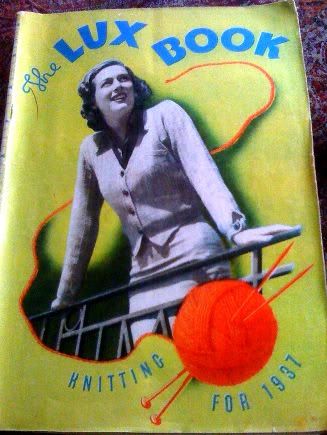
The final booklet for review is the Lux Knitting Book for 1937. This is a fabulous booklet, one of series put out by the Lux Soap Company.

Photobucket

The booklet is 61 pages and along with the black and white photos there are funny and delicate pen and ink drawings of the knit-wear in use, drawings such as you find in the more expensive knitting magazines of that era!

Photobucket

There's something for everyone in this book - men (that chapter is called "Manly Comforts"), women, children, babies and teens...even tea cosies for the tea table!

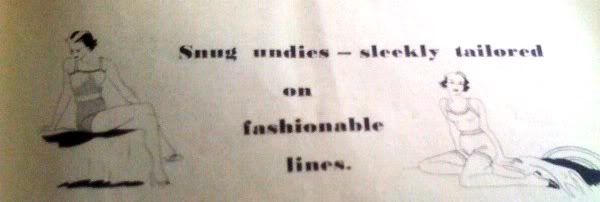
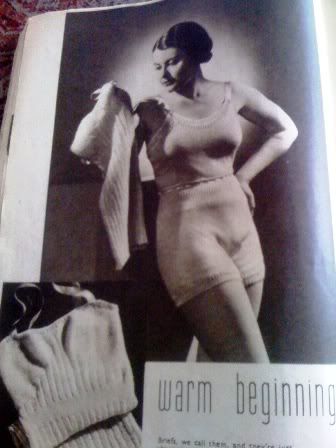
The undies are always cute, called Warm Beginnings, but I always wonder how someone could wear Shetland wool next to their skin?

Photobucket

There is fashion commentary here, too, titled Front Page News in Knitting:

Photobucket

"The editor of this book has been in consultation with the Knitting Editor of Vogue regarding the very latest ideas in knitting and crochet"


So interesting, that little note at the bottom of the fashion page. How do you suppose it happened and what does "in consultation" mean? Do you suppose they 'took a meeting'? How about a phone call? I would have liked to have been a bird on wire overlooking that conversation! In any case, here is what came of it:

A classic winter this, simple straight lines, subtle tailoring to your cardigans... and jumpers with concentrated interest on intriguing stitches. Tailoreds, too, and so much the better if you go utterly masculine and sport a trim and spanking "weskit" with your tweeds - or tuck a man's paisley hankie in the neck of your jumper. For the Rest, keep your neckline up and inflate your sleeves a little at the top.


And yet, the styles in the book are distinctly feminine - more so than in the other three magazines!

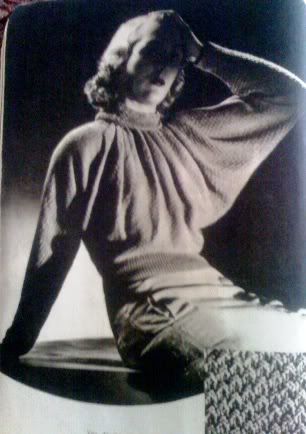
This gathered, dolmen-sleeved blouse, for instance, dramatic and soft:

Photobucket

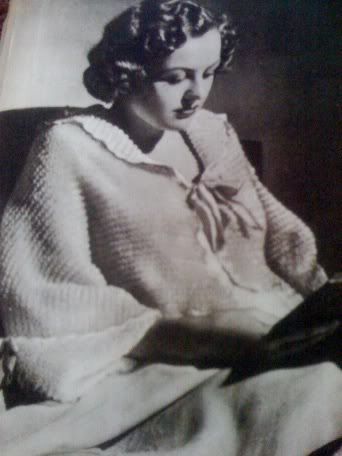
My favorite, though, is this bed jacket and I'm determined to knit it for myself:

Photobucket

It's called Snug Simplicity because it is such a simple pattern. The shape comes from the way the knitting is put together. I can't quote the pattern here, because it is not old enough to be in the public domain, but I can give you some hints!

This is knit in a silk and wool blend (British 2-ply) on 7 mm needles for a size 34 bust. The two pieces are garter-stitch knit in two separate rectangles (with a 15 stitch slit at the central point of one long edge on each rectangle to form the collar) and then half of each short end is sewn to the other in a clever way to form the back, the turned-back collar, and then the sleeves are folded over and sewn.

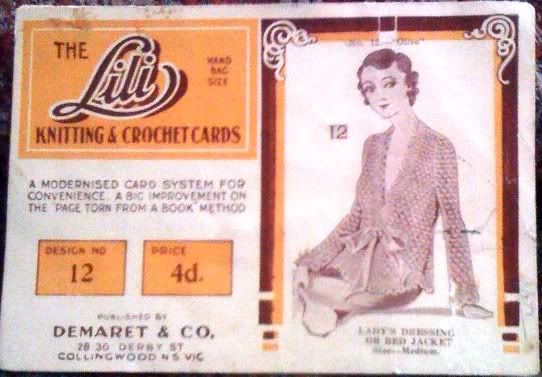
My final treat in this wonderful package was tucked into one of the books - a Lili Knitting Card for another bed jacket!

Photobucket

This is described as "a modernized card system for convenience. A big improvement on the 'page torn from a book' method" The pattern itself would make a great cardigan for summer!

What a super birthday box, wasn't it!?!

Sunday, March 18, 2012

A March Birthday

I had a birthday! My boyfriend took me to Boston:

Photobucket

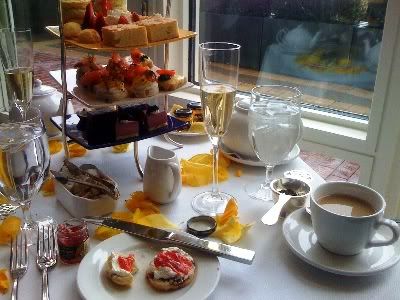
Where he had reserved a table for us at Rowes Wharf for an elegant Afternoon Tea overlooking the water:

Photobucket

It was an incredible tea, with rose petals on the table and champagne, along with the best tea and scones with Devonshire cream...

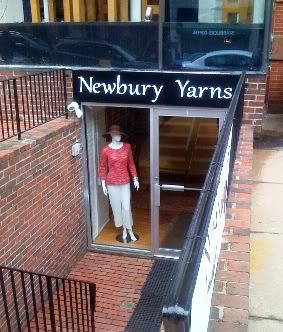
Afterward we wandered a bit down Newbury Street and visited a yarn shop:

Photobucket

and I didn't leave empty-handed:

Photobucket
Koigu, Farm-spun 100% cashmere, and Artyarns Silk Purse 100% silk

(I think I'll make the Linen Stitch Scarf from Churchmouse Yarns and Teas with these yarns)

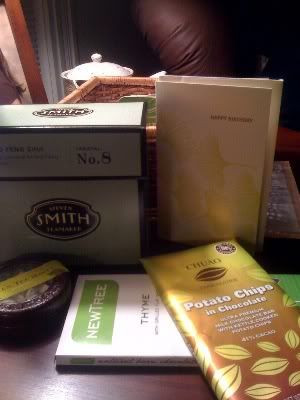
When I came home I had wonderful presents from my best friends:

Photobucket

Yes, that IS a bar with chocolate and potato chips!!

Photobucket

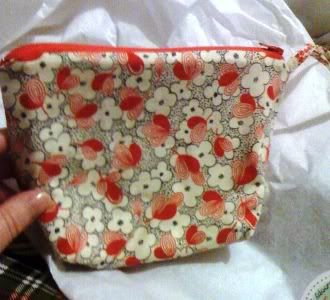
My friend send me a WHOLE BOX of bags she had made! I love this one especially but they're all wonderful.

I love March.

Sunday, March 11, 2012

Crazy Stitch Crazy Love

Photobucket

In many of my oldest needlework manuals, there are several pages of stitch patterns. Over the years, I've noticed an interesting phenomenon. In the earliest booklets - say 1800's through 1905 or so, is crochet stitch called Crazy Stitch but in later years it dies out, never mentioned again.

Photobucket

I find this particularly true of crochet. The stitches wan and wax in popularity and go in and out of fashion. As I've collected books and booklets that span the decades from 1800 through today, I've seen this happen and beautiful stitch patterns that were common 100 years ago are practically non-existent now. I did find one example of the crazy stitch being used about 10 years ago. A blanket posted on the internet as "diagonal crochet" used this stitch, but didn't identify it. Recently, a friend showed me a baby blanket she had made, and I recognized this stitch so it must be around.

As you've gathered by now, I've used this stitch a lot - I've made blankets, scarves, and triangular shawls with it - and each item has an elegant and complex look.

Photobucket

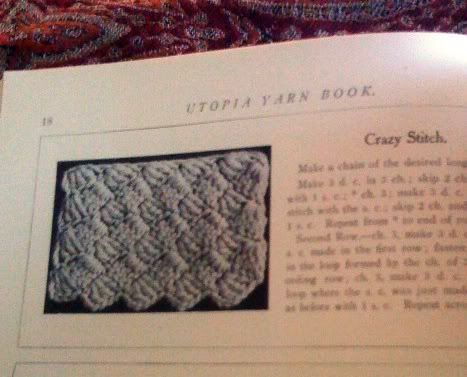
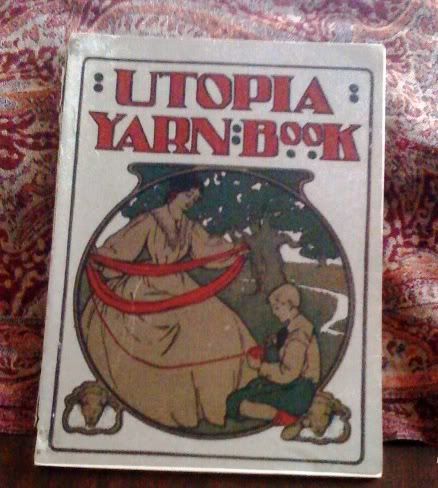
I use the directions from the 1904 Utopia Yarn Book

Photobucket

Make a chain of the desired length.
Row 1 - Make 3 dc in 3 chain; skip 2 chain and fasten with 1 sc. *chain 3; make 3 dc in the same st with the sc; skip 2 ch and fasten with 1 sc. Repeat from * to end of row.
Row 2 - Chain 3, make 3 dc in the last sc made in the first row; fasten with 1 sc in the loop formed by the chain of 3 in the preceding row; ch 3, make 3 dc in the same loop where the sc was just made and fasten as before with 1 sc. Repeat across row.

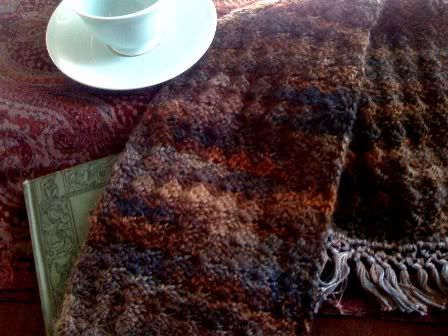
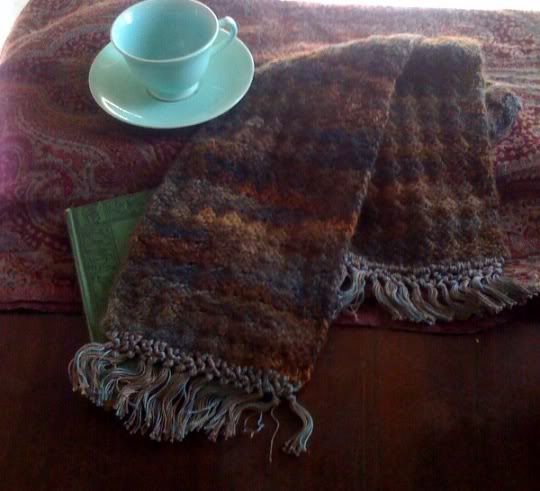
I used this stitch in my soft merino scarf, pictured:

Photobucket

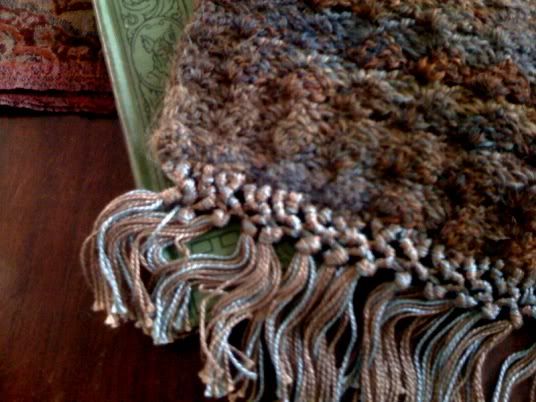
This scarf is 9 pattern repeats across and 48 2-row repeats long. I used Perle Cotton in two colours for the fringe, knotting it for the lacy look. The yarn is 100% merino sport weight, in a discontinued brand, but any soft yarn of any weight would work well.

I love this scarf because it looks like a vintage artifact, even though it's new. And it looks perfect with my camel-hair winter coat! And that's why stitch patterns should never be forgotten - they are timeless, really.

It National Crochet Month (or International Crochet Month, perhaps?) so I've been featuring crochet, but I've discovered some gorgeous Spring sweaters in my Columbia books from the 1930's and I don't think I can wait until April to show them to you!

Friday, March 2, 2012

Art Deco all around

Photobucket

In my last post, I said I'd have a surprise for you at the end, but then I ran out time and this particular surprise takes a lot of time to type out! I had been planning to pour through my old pattern books and find one of the beaded bag patterns for you but then, as I looked at book after book, I found this in a pattern for a stylish sweater:
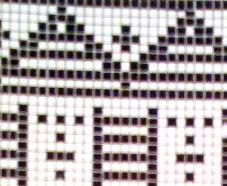
Photobucket

and it reminded me so much of this in style:
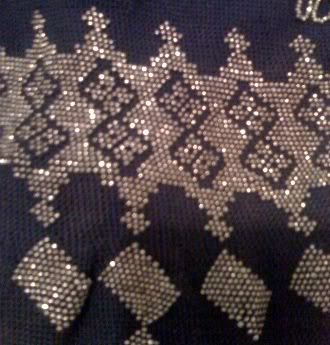
Photobucket

I took a closer look and both the sweater design and the bag were made within just a couple years of each other so... yeah... these were inspired by the Art Deco era that started in Paris in the 1920's.

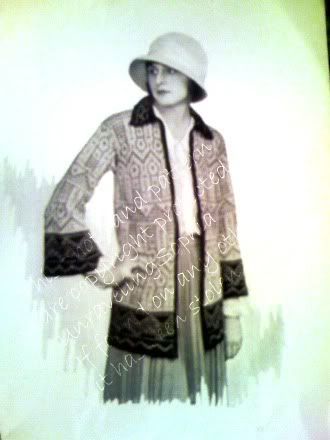
This pattern, The Spencyr Sweater, comes from 1923 Fleisher's Knitting and Crochet Manual, Number 106.
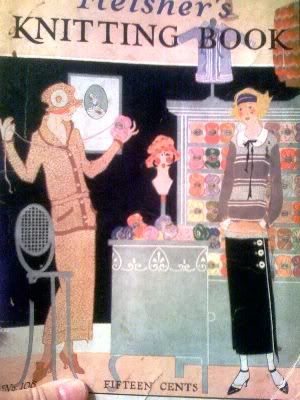
Photobucket

I have the complete series of these manuals, in the original, starting with 1890 and going through 1939, as well as several from the 1940's. It took me about 10 years to collect them! Each one is a complete gem. You can find many of these manuals, in reproduced form, through IvaRose.com. So here it is!

The Spencyr Sweater

~ S.B. and B.W. Fleisher, inc. Philadelphia.
Photobucket

Materials ~ Fleisher's Silverglow Yarn - 5 balls White, 5 balls Henna, 2 balls Black. Needles, 1 pair No. 5 (US). Gauge: 6 stitches and 6 rows = 1 inch square.

[Silverglow was a fingeringweight yarn on the thicker side, like Blue Moon Fiber Arts STR heavyweight]

No size for the finished sweater is given, but in other of their manuals they state that the patterns are sized 36 and to size up or down by changing the needle size and yarn weight.

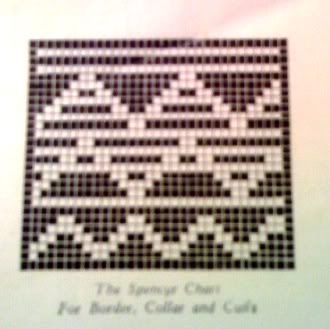
With black yarn cast on 96 inches, Work in stockinette stitch for 1 1/2 inches. Purl 1 row on the knit side to form a hem line and continue in stockinette for 5 rows. Join Henna and start pattern following chart no. 1.
Photobucket

1st row: 1 st henna, *6 stitches black, 2 stitches henna*. repeat between *'s ending with 1 st henna.

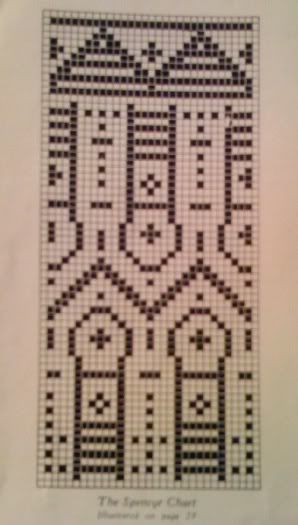
Change to chart for body of sweater. On first row of all white increase to 99 stitches by increasing in the 2nd stitch from each end and also in the center of the row.
Photobucket

Follow chart for the 66 rows and repeat pattern from the 1st white row.

When back measures 21 inches from hem line (20 inches from 1st row of 1st pattern) bind off 5 stitches each side and decrease 1 stitch each side every 2nd row 3 times.

Work even for 5 1/2 inches. This should be the last row of 2nd full pattern. With white yarn work 31 stitches, place on a stitch holder, bind off 21 stitches. On remaining 31 stitches start front, reversing pattern from last row on back.

Work even for 1 inch, then increase at neck edge 1 stitch every other row 3 times and cast on 5 stitches.

Work even on both edges until armhole measures 5 1/2 inches from shoulder, then increase 1 stitch on armhole every 2nd row 3 times and cast on 5 stitches. Finish front same as back to border. Increase 1 stitch at underarm on 1sr row of border and follow chart.
With black, work 5 rows of stockinette, purl 1 row on the knit side and continue in stockinette for 1 1/2 inches. Bind off on wrong side. Make other side to correspond.

Sleeves:
With white pick up 71 stitches around armhole. Reverse pattern of sweater from 28th row of 2nd pattern. When work measures 10 inches increase 1 stitch each side every 2nd row 3 times. Reverse to 23rd row of pattern; this should measure 12 inches; then work border to match border on bottom. Work other sleeve to correspond. Sew up seams and hem bottom.

Band on Front:
With black pick up all the stitches from neck to bottom of sweater. Work stockinette stitch for 3 rows, purl 1 row on knit side, and continue in stockinette for 1 inch. Bind off on wrong side. Make other fromnt band to correspond. Turn both bands on knit line and hem.

Collar:
With black, holding wrong side of sweater toward you, pick up 70 stitches around neck. Work in stockinette for 1 inch. On knit row, knit 25, *knit 2 together, knit 7*, repeat between *'s once, knit 2 together, knit 25. Purl 1 row. Next knit row knit 24, knit 2 tog, knit 6, knit 3 tog, knit 6, knit 2 tog, knit 24.

Join henna. *knit 5, increase 1 stitch in 6th stitch* repeat between *'s twice, knit 27, *increase in next stitch, knit 5* repeat between *'s twice. Work 1 row black as follows: purl 2, increase in next stitch, purl 31, increase in next stitch, purl 31, increase in 3rd stitch from end, purl 2. Join henna. Beginning with 1st row of border chart work 7 rows. After last row of henna, with black work 3 rows of stocinette, purl 1 row on the right side for hem line and 1 1/2 inches of stockinette as before. Bind off on wrong side.

On front edges of collar, holding right side toward you, pick up and knit 16 stitches. Work in stockinette for 3 rows, decreasing at neck end every row. Work 1 purl row on knit side, and stockinette for 1 inch. Bind off on wrong side. Sew hem on collar and hems on edge over the deep hem.

One last note,,,, doesn't the model in the sweater look so like Edith Granville from Downton Abbey?! And this is just the type of sweater that she would wear.